Professor Mark B. Wise
wise@theory.caltech.edu
The most important skill I gained from my mentorship experience was confidence in my abilities. I have always felt overlooked when it comes to science and math, and I think that is partially a function of being a girl. Going into this project, I had no confidence in myself and assumed that everyone I talked to would think I was stupid or a waste of their time. I have had completely the opposite experience. Everyone I have met (particularly Professor Wise and Professor Polchinski) has been incredibly supportive, informative, and helpful. Without the encouragement I received from Professor Cheung and his postdoc, for instance, I highly doubt I would have felt confident enough to take my science project to the science fair or to present my findings to so many professionals. Without the experience I gained, I would never have found the guts to apply at the Griffith Observatory. I now feel much more comfortable taking risks in my thinking and pursuing and presenting new ideas. I know I have ideas that are worth listening to. If we want more women in science, I think girls need the encouragement I received to take risks and be confident in what they have to say. I know at I am good at physics, but I think I needed this experience to show me that I can step out of my comfort zone or think out of the box and come up with completely new ideas.
I met all of the people who have helped me answer my essential question through my mentor, Professor Wise. For example, he introduced me to Professor Sean Carroll who taught me about cloud chambers. This got me interested in methods of particle detection other than colliders and helped lead me to my third answer about dark matter. I could have found the answers to my essential question purely through research, but I would not have gotten the in-depth understanding of and perspective on the most pressing issues of physics that I received from Sean Carroll, Joe Polchinski, Clifford Cheung, and all of the others. By getting this, I was able to differentiate my answers and choose a best answer.
I plan on doing some more mentorship until the year is out.
Much thanks to Professor Wise for taking on a lowly high school student like myself.
Sunday, May 19, 2013

Friday, May 10, 2013
Blog 24: Exit Interview Questions
(1) What is your essential question? What is the best answer to your question and why?
My essential question is "Why is finding supersymmetric particles an important task for physicists to undertake?" My best answer to this question is, "Supersymmetry provides the most complete solution to the problem of the vacuum energy." I chose this as my best answer over all the others because the problem of the vacuum energy (also known as the quantum vacuum or the cosmological constant) is one of the oldest and most confounding unsolved problems in cosmology, and it is one that directly affects the longevity of the universe we live in. According to MIT physicist Max Tegmark in Through the Wormhole with Morgan Freeman, an unstable vacuum means the universe has a much better chance of decaying into a lower energy state (as it did during the Big Bang.) If supersymmetry exists and we understand the method of supersymmetry breaking, this problem will be solved.
(2) What process did you take to arrive at this answer?
Originally, I had wanted to focus on gravity in quantum mechanics and the unification of general relativity with quantum mechanics. However, after I read Leonard Susskind's The Cosmic Landscape and Lisa Randall's Warped Passages, I discovered that string theory cannot include gravity without the existence of supersymmetry. I decided that it was quite possible supersymmetry would provide solutions to other problems in physics and cosmology, so I decided to focus my senior project on it. I discovered that not only does supersymmetry complete string theory, it also resolves the Hierarchy Problem of the Standard Model, the problem of the vacuum energy, and it provides multiple candidates for dark matter that fit well with observations, as I discovered in the numerous papers I read for my science project. When I considered these problems and looked at the enormous cost of experiments dedicated to finding physics beyond the Standard Model, I decided the most important one was the problem of the vacuum energy. As of yet, it cannot be resolved without the existence of supersymmetry, and an unstable vacuum means our universe is due for another Big Bang-esque decay. If physicists do not find supersymmetric particles, they will have to dedicated their time to conceiving other theories to resolve this problem.
(3) What problems did you face? How did you resolve them?
There are almost no women in physics, so whenever I go to functions with my mentor at Caltech or when I hang out with physicists my own age, I feel sort of awkward. I wanted to find a female mentor, since I believe girls need positive female role models to encourage them to go into science and math, but that was nearly impossible. This isn't really a problem I can solve, for I am but a lowly high school student. In the future, I hope to be part of the solution and be a role model for young girls like myself. Also, I was in no way equipped to do the math, so I buckled down and taught myself calculus online and from a book, with help from the grad students at my mentorship.
(4) What are the two most significant sources you used to answer your essential question and why?
The two most important sources I used were my fourth interview with Joe Polchinski of the Institute for Theoretical Physics at UC Santa Barbara. He gave me the most in-depth analysis of superstring theory, supersymmetry and quantum gravity I had gotten. Before this interview I had ignored the problem of understanding supersymmetry breaking, but his explanation made me understand its significance. My second most important source was a paper called Implications of a 125 GeV Higgs for Neutralino Dark Matter in the MSSM by Howard Baer, Vernon Barger and Azer Mustafayev. Apart from being the first real technical paper I learned to decipher, this was the most current analysis of supersymmetric parameter space and its implications with the most accurate measurement of the Higgs mass.
(5) What is your product and why?
I used to not understand why people dedicate their whole lives to studying the universe, which appeared to me as a cold, hostile, lifeless place. Why did no one care about our little swatch of the universe, where more and more terrible things seemed to be happening everyday? Now that I've done my science project and done all of this research, I understand what drives people to spend their whole lives in pursuit of discovery. I have greatly increased my own curiosity about the universe and, in doing so, broadened my view of life on Earth. I realize we are all pretty much the same-just recycled atoms from old stars that have grown sentient. I was afraid studying physics would turn me into Edward Teller or Werner Heisenberg, but instead I feel more like Erwin Schrodinger, who never let the turmoil of the 20th century interfere with his quest for discovery, or allowed his scientific ambitions to turn him away from the people in this world. I think if more people understood where we came from, the world would be a much more harmonious place.


Enjoy this picture of the Cosmic Microwave Background Radiation courtesy of the Planck Satellite. This is the universe at the youngest we can see it. If you turn your radio to white noise, you can hear this buzzing about. The universe is talking to you!
Wednesday, May 8, 2013
Blog 23: 2014 Interview
1. Who did you interview and what house are they in?
Jeremy Etheridge-I honestly have no idea what house he is in.
2. What ideas do you have for your senior project and why?
J: EMT or something having to do with first aid, because that's what my dad does and I've always liked helping people.
3. What do you plan to do for your summer 10 hour mentorship experience?
J: I plan on working with my dad.
4. What do you hope to see or expect to see in watching the 2013 2-hour presentations?
J: I'm expecting to understand more about how exactly we are supposed to present it, because right now I really have no idea. I know we are supposed to be teaching a class, but I am hoping to see more of the specifics about what exactly will we be presenting on.
5. What questions do you have that I can answer about senior year or senior project (or what additional information did you tell them about senior year or senior project)?
J: I've heard it's a lot of work.
H: It is, but as long as you manage your time well, you'll be fine. Like, they'll give a two-month deadline. You'll think that's a long time, but all of a sudden you'll figure out you have a week left to go and you will have done nothing. As long as you do a little bit everyday, maybe 10 minutes or so, it won't seem like that much work.
J: How do the house competitions work?
H: Well, Mr. Purther sets those up. Sometimes it's capture the flag or kickball. Lately we've been playing word games and chess. Usually they happen on Friday, since we always seem to have a big chunk of downtime for some reason. Anyway, the house that wins gets one point and the winning house gets to go to grad night for free. Oh, and charity stuff is a house competition. For instance the house that donates the most cans gets a house point.
Thank you Jeremy! Good luck in ASB next year!
Jeremy Etheridge-I honestly have no idea what house he is in.
2. What ideas do you have for your senior project and why?
J: EMT or something having to do with first aid, because that's what my dad does and I've always liked helping people.
3. What do you plan to do for your summer 10 hour mentorship experience?
J: I plan on working with my dad.
4. What do you hope to see or expect to see in watching the 2013 2-hour presentations?
J: I'm expecting to understand more about how exactly we are supposed to present it, because right now I really have no idea. I know we are supposed to be teaching a class, but I am hoping to see more of the specifics about what exactly will we be presenting on.
5. What questions do you have that I can answer about senior year or senior project (or what additional information did you tell them about senior year or senior project)?
J: I've heard it's a lot of work.
H: It is, but as long as you manage your time well, you'll be fine. Like, they'll give a two-month deadline. You'll think that's a long time, but all of a sudden you'll figure out you have a week left to go and you will have done nothing. As long as you do a little bit everyday, maybe 10 minutes or so, it won't seem like that much work.
J: How do the house competitions work?
H: Well, Mr. Purther sets those up. Sometimes it's capture the flag or kickball. Lately we've been playing word games and chess. Usually they happen on Friday, since we always seem to have a big chunk of downtime for some reason. Anyway, the house that wins gets one point and the winning house gets to go to grad night for free. Oh, and charity stuff is a house competition. For instance the house that donates the most cans gets a house point.
Thank you Jeremy! Good luck in ASB next year!
Friday, May 3, 2013
Blog 22: Final 3-Column Chart
https://docs.google.com/spreadsheet/ccc?key=0AlCsYHBSZf56dHVlM0ZyNFVpeU1QTzBpbU5SZ3dCSmc#gid=0
Thursday, April 25, 2013
Blog 21: Independent Component 2
I, Hannah Seymour, affirm that I completed my independent component which represents 30 hours of work.
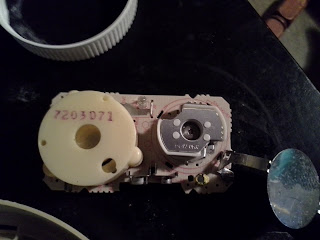
I first learned about cloud chambers from Caltech physicist Sean Carroll. He also taught me how to extract the tiny radioactive americium-241 disk from an ionizing smoke detector. For the experiment procedure I used this website: http://www.bizarrelabs.com/cloud.htm.
A cloud chamber is a very basic particle detector. To build a simple cloud chamber, you need a see-through container (I used a glass jar for science labs involving poisonous materials, as I was sure it would be radiation-safe,) very pure alcohol (I used 91% isopropyl rubbing alcohol,) a piece of blotter paper or sponge, a piece of black cloth, a block of dry ice, and a small radioactive piece. In this case, I used Fiestaware which contains uranium, and the americium from a smoke detector (if you want to try this, please use a broken smoke detector like I did.)
The cloth is glued to the bottom of the lid and the sponge is soaked in the alcohol. The radioactive source is placed in the lid and the jar is screwed upside-down onto it. Then the jar has to sit for 10-15 minutes or so. After that, the jar is placed lid-down onto the dry ice so the alcohol can saturate the jar and vaporize. After 15-20 minutes, when the jar becomes very cold, particle trails will begin to appear. A mist also forms and sinks to the bottom of the jar. Alpha particles leave heavy, dense trails and beta particles leave thin, wispy trails. This works because when a charged particle enters the chamber (from the radioactive source) it ionizes the vapor and produces a mist. There are so many ions produced around these relatively high-energy particles that when the vapor around them condenses a trail is left.
The cloud chamber was one of the very first particle detectors and was used to discover muons and kaons among others. However, interestingly enough, today's high-tech dark matter searches actually utilize many of the same principles that the old-school cloud chamber does. For example, a popular type of experiment uses extremely pure, extremely cold germanium atoms in a controlled environment sealed off from the outside world, sometimes buried deep within an old abandoned mine. Theoretically, a dark matter WIMP (Weakly Interacting Massive Particle) should hit these supercool germanium atoms, which are very still, and leave a trail in the form of it's interaction with the germanium by causing it to "move," in a sense.
Supersymmetric particles are excellent candidates for WIMPs, and I believe the best way for them to be detected is through a dark-matter detection experiment like the germanium one. And if they are found in this way, we are well on the road to solving two of the most elusive problems in physics-dark matter and the existence and nature of supersymmetric particles. From this, I have the third answer to my essential question, "Why is finding supersymmetric particles an important task for physicists to undertake?" "Because supersymmetric neutralinos provide the most accurate candidate for Cold Dark Matter."




Cutting the sponge-diameter 6.5 cm

Sponge layer


Completed parts-notice new lid

Set-up at school

The Geiger counter goes nuts around these two

Fiestaware-don't handle with your bare hands!


Letting sit-right before I put it on the dry ice

Broken smoke detector

I had to take this apart wearing gloves

The americium is the tiny, tiny button resting on the center disk

Letting it sit before it goes on dry ice
Monday, March 25, 2013
Tuesday, March 5, 2013
Blog 19: Senior Project and ESLRs
1. What ESLR have you excelled in most in your senior project?
Oy vey, I don't think any of these are really applicable. If I had to choose one I would choose Effective Communicator.
2. Please explain why you think you have excelled in this ESLR.
One of my goals is to help others understand physics. Sure, it's great that I understand it, it comes naturally to me, blah blah blah. Whatever. My knowledge of physics isn't something I want to just keep selfishly to myself. Everyone can understand physics and appreciate it! No one should be made to feel intimidated. I have been helping people out when they need it in Pittman's class (I hope this has been beneficial for people. If not please tell me how I can improve.) I'm really trying to make my presentations accessible and interesting for people, and many people I have asked say that they have learned something after my presentations. I have a degree of artistic talent, so I try to use visual representations that are cute/funny/memorable to teach people. Also I make a lot of jokes (which may or may not be funny...or may be funny and not funny simultaneously until they are observed...I'll show myself out.)
3. Provide evidence from your senior project to support your claim (evidence is a photo of something you are doing, photo of something you made, etc).
I'll post a picture in the morning, but today I drew the little cartoony versions I do of all the Manhattan Project scientists. I drew these for Ogden's first art project but I have no idea where that has gone to (Purther, where are they?) So here are these instead. I'm thinking about making a historical physics comic, since there are many important aspects in this era that are glossed over in school. Here they are thinking about something they like. Oppenheimer likes Hinduism, Teller likes hydrogen, Szilard likes baths, and Fermi likes aliens.
Oy vey, I don't think any of these are really applicable. If I had to choose one I would choose Effective Communicator.
2. Please explain why you think you have excelled in this ESLR.
One of my goals is to help others understand physics. Sure, it's great that I understand it, it comes naturally to me, blah blah blah. Whatever. My knowledge of physics isn't something I want to just keep selfishly to myself. Everyone can understand physics and appreciate it! No one should be made to feel intimidated. I have been helping people out when they need it in Pittman's class (I hope this has been beneficial for people. If not please tell me how I can improve.) I'm really trying to make my presentations accessible and interesting for people, and many people I have asked say that they have learned something after my presentations. I have a degree of artistic talent, so I try to use visual representations that are cute/funny/memorable to teach people. Also I make a lot of jokes (which may or may not be funny...or may be funny and not funny simultaneously until they are observed...I'll show myself out.)
3. Provide evidence from your senior project to support your claim (evidence is a photo of something you are doing, photo of something you made, etc).
I'll post a picture in the morning, but today I drew the little cartoony versions I do of all the Manhattan Project scientists. I drew these for Ogden's first art project but I have no idea where that has gone to (Purther, where are they?) So here are these instead. I'm thinking about making a historical physics comic, since there are many important aspects in this era that are glossed over in school. Here they are thinking about something they like. Oppenheimer likes Hinduism, Teller likes hydrogen, Szilard likes baths, and Fermi likes aliens.
Subscribe to:
Posts (Atom)